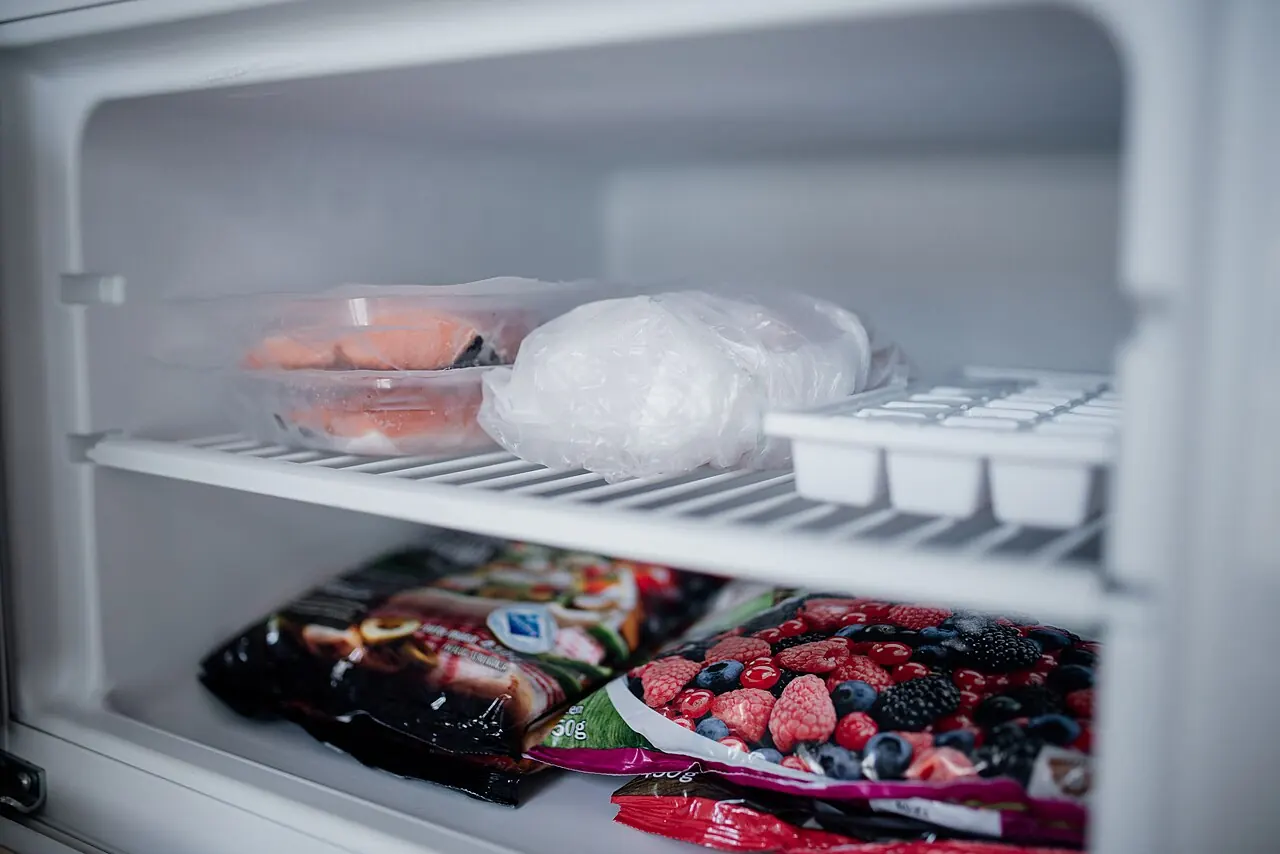
A chicken breast with a pale, dry corner can look less appetizing than a perfectly pink package that thawed in a failed freezer. The ugly one may be usable. The attractive one may need to go. That mismatch is why judging frozen food by appearance alone leads to both wasted groceries and unsafe decisions.
Separate two questions before opening the package: did the food stay safely cold, and will its texture and flavor still be worth eating? Freezer burn answers the second question. It cannot answer the first, and trimming away a dry patch cannot repair an unsafe storage history.
What the dry patches actually mean
Freezer burn happens when air reaches food and its surface dries. USDA describes grayish-brown, leathery spots; frozen meat and poultry can also develop whitish dried areas. The affected portion may become tough or lose flavor. This is a quality defect, not evidence that freezing has poisoned the food.
According to USDA FSIS guidance on freezer burn, affected portions can be cut away before or after cooking. If damage covers most of a small piece, discarding it for quality can be reasonable. You do not have to turn every disappointing ingredient into a rescue project.
Color changes are a separate complication. USDA notes that frozen meat can darken or turn pale brown without becoming unsafe. A brown patch is not automatically spoilage, and a bright color is not a safety certificate. Ice collected inside a bag also does not establish the package's complete history. Look beyond the photograph you could take of it.
Reconstruct the cold chain before judging dinner
Start with what happened before freezing. Was the meat refrigerated promptly? Were leftovers put away while still within safe handling limits? A freezer pauses microbial growth; it does not erase unsafe time on the counter. USDA explains that microbes made inactive by freezing can become active again after thawing.
Next ask whether the freezer kept working. The normal storage target is 0 F or below, checked with an appliance thermometer. A control marked with numbers or a word such as cold is not a temperature measurement. If you returned from a trip to softened packages, the temperature now cannot necessarily tell you how warm they became before the appliance recovered.
Finally, distinguish a known event from a guess. An outage you noticed immediately gives you a starting time. A door found ajar after an unknown interval does not. Write down the evidence you have: time discovered, thermometer reading, which packages remain icy, and whether raw juices leaked. Do not manufacture a missing timeline from the fact that something feels cool.
The mechanics of protecting the remaining cold food are covered in how to keep food cold during a power outage. Make that arrangement before spreading packages across the counter for a lengthy inspection.
A package-by-package decision, not a freezer-wide verdict
One item near an open door may warm sooner than food buried farther inside. Evaluate each questionable package rather than keeping or discarding everything because of one representative item. Use a food thermometer where appropriate, and clean it between foods so the inspection does not spread raw juices.
| What you know | What it supports |
|---|---|
| Safe handling, continuous frozen storage, dry surface spots | A quality decision: trim affected areas or discard if too damaged. |
| Food still contains ice crystals or is at 40 F or below after an interruption | Refreezing is generally possible; check food-specific exceptions. |
| Meat, poultry, seafood, soup, or a frozen meal spent more than two hours above 40 F | Discard rather than refreeze or cook to salvage. |
| Perishable food may have warmed too long, but the duration is unknown | Do not keep it on the strength of appearance or smell. |
The federal frozen-food outage chart includes exceptions that matter. It directs disposal of thawing ice cream and frozen yogurt even in its ice-crystal column. Plain breads and some other foods have different instructions. A cheese-filled pastry should not be treated like a plain roll simply because both came from the bakery aisle.
Smell can reject food, but cannot clear it
An off odor, slime, or unexpected mold is a reason not to use food, not an invitation to trim, rinse, or season the problem away. However, harmful bacteria need not announce themselves with those changes. FDA specifically warns that food can cause illness without looking, smelling, or tasting spoiled.
Never take a small bite to settle an argument about safety. Do not offer the suspect portion to someone else as a taste test. A normal smell after thawing does not overrule a known unsafe warm period, and a seasoning packet does not change the decision.
Cooking is not a universal reset either. FDA notes that some toxins formed during unrefrigerated storage can survive cooking. The useful distinction is not raw versus cooked; it is safely handled versus temperature-abused. The same limitation applies to a casserole that was fully cooked before it went into the freezer.
When the household disagrees
Use a factual sentence rather than a visual debate: the package has dry spots and stayed frozen, or the package was warm for an unknown time. Those are different problems. If nobody can establish a safe history for a perishable item, the disagreement cannot be resolved by sniffing it more carefully.
Three familiar finds, three different outcomes
The old bag of chicken: You froze it while fresh, the freezer has remained at 0 F, and the bag has a loose seal with dried edges inside. This fits a freezer-burn quality problem. Thaw safely if needed, trim the dry areas, and decide whether enough usable food remains for the meal you planned.
The soft package after an outage: Some food is no longer solid, but it still contains ice crystals and its temperature is 38 F. That supports keeping or refreezing foods covered by the general rule, though texture may suffer. Check the specific food category instead of applying the meat rule to ice cream.
The frozen-solid package after a weekend away: You know the power failed and returned, but not how warm the food became or for how long. Being solid now does not prove it stayed safe earlier. Without reliable evidence of a safe temperature history, do not use current hardness to clear a questionable perishable.
For a wider kitchen sort, including the refrigerator, use what food to throw away after a power outage. Frozen storage and refrigerated storage are not interchangeable timelines.
Using the food you have decided to keep
Choose a recipe after making the safety decision, not as a way to avoid it. A safely stored roast with a few dry edges may be more useful cut into a sauced dish than served as a centerpiece. Moist cooking can make remaining edible portions more pleasant, but it cannot guarantee that heavily dried food will regain its original texture.
Thawing deserves the same attention as storage. USDA recognizes refrigerator, cold-water, and microwave methods. Do not leave a package on the counter until it becomes easy to cut. Food thawed in cold water or a microwave should be cooked immediately; refrigerator thawing offers more flexibility.
Keep thawing raw meat contained so juices cannot reach ready-to-eat foods. If leaked raw juices contaminate food you will not cook, USDA advises discarding that food. A bag of bread sitting underneath a leaking chicken package is not merely another freezer-burn question.
Wrap the next batch around the way you actually eat
USDA recommends food-grade freezer materials that limit air exposure, such as heavy freezer bags, freezer wrap, or heavy-duty foil. Thin supermarket wrapping can allow air through; overwrap meat intended for longer storage. Remove excess air from bags and close them securely rather than relying on a loose folded top.
Pack meal-sized portions. Opening one large bag repeatedly exposes food you are not using, and an oversized block encourages inconvenient thawing decisions. Label each portion with the food name and freezing date. For leftovers, recording the cooking date as well makes the history easier to reconstruct.
Make a small use-first area for packages with damaged wrapping or early drying, provided their safety history is sound. Rewrap them and put an actual meal beside the item on your shopping list. Better packaging prevents more disappointment than adding another unidentified container to the back of the freezer.
Before shutting the door, check that no bag or box is keeping it from sealing. Leave the thermometer readable and return the food promptly. The next time an unappealing patch appears, you will have something more useful than a guess: a known storage history and a clear choice about quality.
Photo: Shixart1985, CC BY 2.0. Cropped and resized for this article.