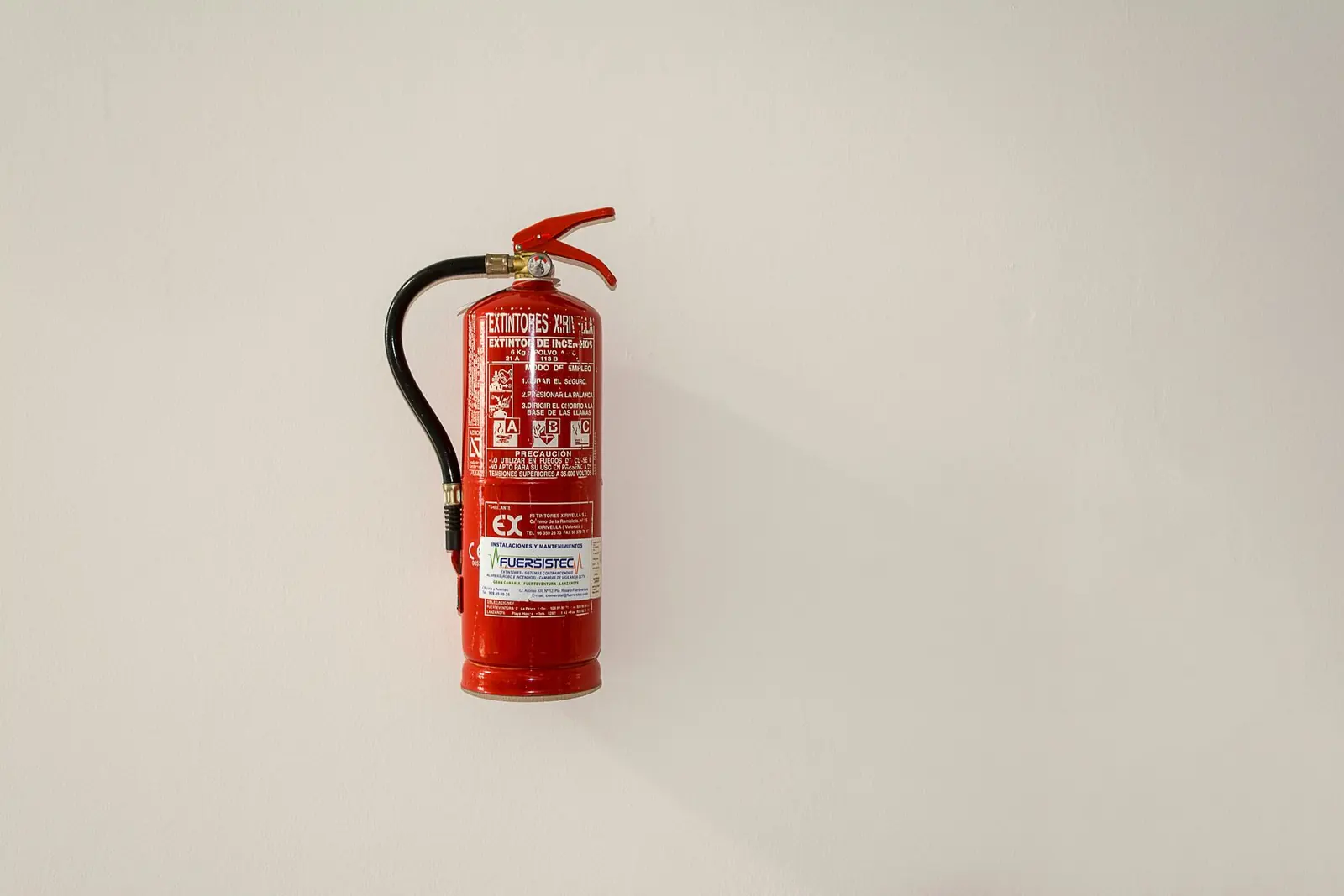
Two red cylinders can look nearly identical on a store shelf and still protect against different fires. One may cover ordinary household combustibles as well as flammable liquids and energized electrical equipment. Another may cover only the last two. The largest-looking model may also be too awkward for the person expected to carry it.
Choosing a home fire extinguisher is therefore a label, handling, and placement decision, not simply a purchase by color or price. It also starts with a limit: owning one does not obligate you to use it. Escape and a call to the fire department take priority over saving property.
Decide the conditions for use before choosing the cylinder
The U.S. Fire Administration's extinguisher guidance asks whether others have been alerted, the fire department has been called, the user is physically able, the fire is small and contained, smoke does not threaten the user, and a clear escape route exists. All must be true before use is considered.
If any answer is uncertain, leave and call 911 from safety. A spreading fire, a smoke-filled room, or a fire between you and the door is not a situation for testing your new equipment. Do not delay leaving to locate a phone, identify an unknown fuel, or retrieve an extinguisher from another floor.
Decide explicitly who will evacuate rather than operate equipment. Children should get out, not be assigned a fire-fighting role. USFA also advises that older adults should not use extinguishers. Build the household response around each person's abilities and the fastest safe exit, not an assumption that everyone must try.
Read the letters as a list of approved fire types
A multipurpose A-B-C model is a sensible starting point for common household hazards, but the printed classification is what matters. A kitchen picture, garage name, or general safety claim does not replace the actual rating. Compare the letters on the label with the materials in the space.
| Class | Fire involved | What that means while shopping |
|---|---|---|
| A | Ordinary combustibles such as wood, paper, and cloth | Needed for coverage of these common household materials. |
| B | Flammable or combustible liquids such as gasoline and some oils | Relevant to liquid-fuel hazards; does not mean every cooking situation is covered. |
| C | Energized electrical equipment | Indicates a suitable nonconductive extinguishing agent, not permission to repair wiring. |
| D | Combustible metals | Specialized coverage, not the same as ordinary household A-B-C protection. |
| K | Cooking oils and fats in cooking appliances | Common in commercial kitchens; seek advice for specialized cooking hazards. |
A B-C extinguisher lacks the A classification. That matters if the fire involves a wooden cabinet or paper wastebasket. Conversely, the presence of C does not turn the extinguisher into electrical protective equipment. You still need a safe exit and must avoid smoke, damaged wiring, and energized components.
Do not shop only to avoid residue
Different agents have different limitations. OSHA's extinguisher basics explains that carbon dioxide models generally cover B and C rather than A and can create hazards in confined spaces. A product being cleaner for equipment does not make it the right general-purpose choice for your household.
Separate the fire rating from the weight
The numbers before A and B describe rated extinguishing capability, not the cylinder's weight. For example, a label reading 2-A:10-B:C conveys more than the letters alone. A higher number in the same class indicates greater rated capability for that class; C does not carry a numerical size rating.
These are standardized ratings, not a promise that you can safely tackle a fire of a particular apparent size at home. Do not translate the B number into a floor area you are willing to fight. Real rooms have smoke, heat, obstructions, and escape constraints that a label cannot assess for you.
Look separately for the filled weight, dimensions, discharge instructions, and operating temperature range. A description based on agent weight may not equal the total amount you must lift. For a garage location, compare the manufacturer's storage range with the temperatures that space actually reaches.
USFA recommends a UL Listed or ULC Listed product and the largest extinguisher the user can operate safely and comfortably. Verify the certification mark on the actual product, rather than assuming a familiar seller or an online listing title establishes approval.
Choose a size you can control without a struggle
Ask to handle a display model safely with the pin and seal intact. Can the intended adult lift it, carry it without dragging, and understand how to direct the hose or nozzle? A high rating has limited practical value if the cylinder stays on its bracket because the user cannot manage it.
Compare the release mechanism on the mount as carefully as the handle. Read the instructions while calm and check whether the safety labeling is legible to the person who may use it. Do not pull the pin or discharge the product as a store demonstration or home practice exercise.
Consider a compact apartment where a heavy cylinder must be lifted from a narrow cupboard. A more manageable listed model in an accessible location may fit that household better. If the workable choices seem too limited for the hazards, ask the fire department for advice rather than assuming a heavier unit solves the problem.
Keep this purchase in proportion to the rest of the home. Working alarms and usable escape routes belong ahead of collecting multiple extinguishers. The priorities in simple fire safety fixes help identify gaps that another cylinder will not address.
Place it where a fire will not cut off access
Pick the location before checking out. New Mexico's state fire safety guidance recommends easy-to-reach locations near exits. Think through the route from that position to outdoors. You should not need to pass the likely fire to retrieve equipment or turn away from your escape path to use it.
A unit behind the stove, over a cooking surface, or buried beneath cleaning supplies can become inaccessible at exactly the wrong time. Near a kitchen exit is a different proposition from directly beside the burner. Keep doors, furniture, and storage from hiding or obstructing the chosen spot.
Use the manufacturer's mounting arrangement and instructions. Have a qualified installer handle a location where fixing the bracket could strike concealed utilities or otherwise exceed your skills. Do not improvise a loose hook that cannot support the cylinder or leave it where it can fall.
Walk the location with other adults in the home. In a multilevel or unusually shaped house, ask the local fire department about appropriate distribution rather than treating one distant extinguisher as whole-home coverage. A renter should also clarify which equipment management provides and maintains.
Give cooking fires their own decision
Do not interpret a multipurpose label as encouragement to approach a burning pan. USFA's cooking fire guidance recommends keeping a lid or baking sheet nearby to cover a pan fire. Only attempt this when the fire is small and you can act safely without reaching through flames; otherwise leave.
Never carry a burning pan outdoors or pour water onto burning oil. If a lid can be applied safely, turn off the burner if accessible without exposure and leave the pan covered to cool. Do not lift the lid to check repeatedly. A fire that has spread beyond the pan calls for escape and the fire department.
For deep-frying or unusual cooking equipment, ask the fire department about the specific hazard and extinguisher suitability. Class K commonly serves commercial cooking risks. It is neither necessary to turn every home kitchen into a commercial installation nor safe to assume an ordinary B rating covers every hot-oil appliance.
Buy a maintenance arrangement you can actually follow
Read whether the model is rechargeable or disposable before purchase. Rechargeable equipment requires professional servicing when needed. Disposable equipment is replaced rather than refilled. Do not decide which you have solely from handle material, cylinder color, or whether a gauge is present.
Follow the model's inspection and service instructions. A regular visual check should include access, the indicated pressure or status, pin and tamper seal, readable instructions, and damage to the cylinder, hose, or nozzle. Set a monthly reminder if consistent with the manual. A gauge in the proper range is one check, not proof that every component is sound.
After any discharge, follow the manufacturer's recharge or replacement instructions; do not return a partly used unit to service. First Alert's manufacturer FAQ explains this distinction and warns against testing by discharge. Leave cylinder opening, pressure work, and refilling to qualified service providers.
For equipment already in the home, record the model and date information and check the CPSC recall database. Appearance cannot establish that an inherited unit is unaffected by a recall. Follow the actual notice if there is a match.
Learn the motion, then practice choosing to leave
Ask the local fire department about training. PASS means pull the pin, aim at the base, squeeze the handle, and sweep side to side. Follow the particular model's instructions and effective range. Memorizing those letters does not supply the judgment or handling practice a training session can provide.
Keep a clear escape route behind you, and stop if the fire grows, smoke threatens, or the unit empties without putting it out. Do not go looking for a second cylinder. OSHA's use guidance makes evacuation the response to fire progressing beyond its earliest stage. Even if flames disappear, do not cancel the emergency response or reenter until firefighters permit it.
Complete the purchase by mounting the extinguisher, saving its instructions, and showing household adults where it is. Add its location to your room-by-room home safety check. Then ask one question from that spot: if this room fills with smoke, which door will I leave through?
Photo: Jan van der Wolf, Pexels License. Cropped and resized for this article.